Pawlo
PawloHow to Feed Multiple Pets Without Food Stealing or Chaos
Multi-pet feeding is one of those problems that sounds simple and definitely isn't. Here's what actually works to keep every pet eating their own food, on their own schedule.
If you have one pet, feeding is a non-event. You put food down. They eat it. Done.
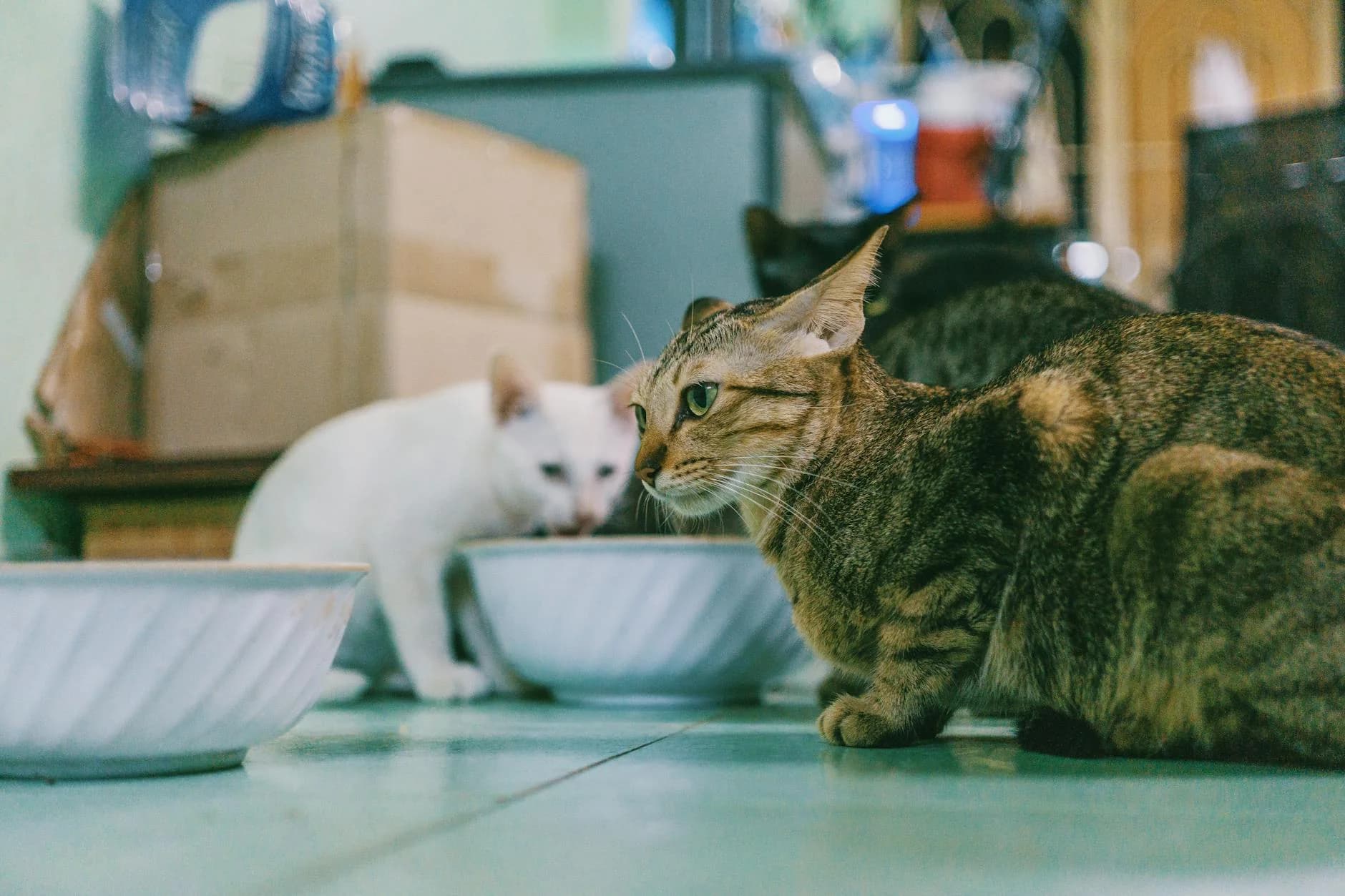
If you have two or more pets, feeding is a twice-daily logistics operation that can involve territorial behavior, dietary conflicts, a 15-pound tabby who has decided that whatever is in the other cat's bowl is definitely better, and a dog who has learned that the cat's elevated feeding station is actually reachable if she jumps just right.
Multi-pet feeding is one of the most common questions in pet owner communities, and the answers that get repeated most often are either oversimplified or require equipment most households don't want to buy. Here's what actually works, in order of effort.
Pawlo is the free shared pet care app for roommates — one synced list for the whole apartment, receipts on every task. →
Why Multi-Pet Feeding Goes Wrong
Before the solutions, it's worth naming the actual problems, because they're not all the same:
Food theft. One pet eats fast and then moves to the next bowl. Or one animal is simply more food-motivated and will always push the other aside.
Dietary conflicts. Dogs need dog food. Cats need cat food. These are not interchangeable — cat food is significantly higher in protein and fat, and dogs who eat it regularly can develop pancreatitis and other issues. Cat food is also typically higher in calories, which can accelerate weight gain in dogs who sneak it regularly.
Medical dietary requirements. One pet is on prescription food. Another needs a low-phosphorus diet. A third is on a weight management formula. Mixing these up isn't just a waste of money — it can actively undermine a pet's health management.
Pace mismatches. One pet grazes slowly. Another inhales their bowl in ninety seconds and then immediately investigates the slower eater's food. Free-feeding works for the grazer but creates chaos the moment a second animal is involved.
Tracking confusion. With multiple pets, it's genuinely hard to know which animal has been fed and which hasn't — especially in a multi-person household where different people feed on different shifts.
Method 1: Separate Rooms
The simplest and most reliable solution for most households. Feed each pet in a separate room with the door closed until they finish. When everyone is done, bowls come up and doors open.
Why it works: There's literally no way to steal food from behind a closed door. It also works for dietary separation regardless of species or food type.
Downsides: Requires you to be present and supervising. Takes a few extra minutes at each meal. Some pets don't like being isolated and will scratch at the door rather than eat.
Best for: Households with 2–3 pets who have clear individual dietary needs, or one pet who guards their food. This is the method most veterinarians recommend as a starting point.
Method 2: Elevated Feeding for Cats
If your problem is specifically a dog raiding the cat's bowl (extremely common), a cat feeding station on a counter, shelf, or elevated surface the dog can't access solves it without separating rooms. Cats prefer elevated positions anyway — many cats will actually eat more reliably from a height.
Why it works: Cats are climbers. Most medium and large dogs can't follow them up. This also allows cats to eat at their own pace without feeling rushed.
Downsides: Doesn't work if your dog is athletic or if your cat is elderly or arthritic and can't comfortably jump. Doesn't address cat-to-cat food stealing.
Best for: Dog-and-cat households where the dog is the food thief.
Method 3: Microchip-Activated or Collar-Activated Feeders
These feeders contain a lid that opens only when the assigned pet's microchip (or an RFID collar tag) is detected. Approach with the wrong pet, and the lid stays closed. Only the assigned animal can access their food.
Why it works: It's the most technically complete solution to the food-stealing problem. Each pet can eat on their own timeline without you needing to supervise or separate them physically.
Downsides: Cost — quality microchip feeders run $50–$150 per unit. You need one per pet. Some pets take time to learn how to use them. Doesn't work well for wet food (lids can seal in smell, some models aren't designed for wet food). Requires your pet to be microchipped, or adding RFID collar tags.
Best for: Cat-only households with free-feeders who steal each other's food, especially where one cat is on prescription or weight-management food. Less practical for large dogs or mixed-species homes.
Method 4: Timed Sequential Feeding (Supervised)
Put all bowls down at the same time. Stay present and supervise. The moment any pet finishes their bowl, pick it up — don't let them move to another bowl. Slow eaters get protected time. When the slowest eater finishes, meal time is over and all remaining food comes up.
Why it works: Doesn't require equipment or room separation. Works well when the issue is one fast eater poaching from one slow eater.
Downsides: Requires you to be present for every meal. Not practical if you're not home during midday feedings. Stressful if you have a pet who guards their bowl aggressively.
Best for: Households where the problem is pace mismatch rather than dietary restriction, and where at least one person is home for all meals.
Method 5: Scheduled Meal Feeding (Not Free Feeding)
This one sounds obvious but it's worth saying explicitly: if you're free-feeding (leaving food out all day), multi-pet feeding is much harder. Switching to scheduled meals — twice daily, food down for 15–20 minutes and then up — dramatically simplifies management for all other methods.
Scheduled feeding also tells you which pet isn't eating, which is valuable health information. A cat who skips two meals is a cat worth monitoring. You'd never know that on free-feeding.
The tradeoff: Some pets genuinely do better grazing, particularly cats, and some cats will not eat reliably under meal pressure. Know your animals.
The Multi-Person Household Layer
All of the above gets more complicated when multiple people are responsible for feeding. The food-stealing problem is hard enough — add a partner or roommate who doesn't know which cat was already fed, and you've added another failure mode on top.
In a multi-person household with multiple pets, you need a system for tracking not just when each meal happened but which pet was fed. "I fed them" doesn't tell you whether both cats got their correct food.
Pawlo handles this by letting you create individual feeding tasks per pet. "Luna — Morning Feed" and "Mochi — Morning Feed" are separate tasks. When one person marks Luna's meal done, it stays visible to the other household member — so they know not to feed Luna again, but can see that Mochi's bowl still needs to go down. For households with special dietary needs, the task can include a note with the specific food and portion.
This becomes especially important with medical diets. If one cat is on kidney-support food at $90 a bag, knowing exactly who fed what prevents expensive mistakes — and your vet will thank you for having a complete feeding history.
Common Scenarios and What Works
"My cat keeps eating my other cat's food"
Start with separate rooms. If that's not practical, microchip feeders are the cleanest solution. If one cat has a medical diet, separate rooms are non-negotiable — the stakes are too high for equipment to be optional.
"My dog eats the cat food"
Elevated feeding station for the cat. This is usually the fastest fix with the least friction for anyone involved.
"I have a cat who grazes and a dog who inhales everything"
Separate rooms every meal, or a microchip feeder for the cat so they can graze safely. Free-feeding a cat while also having a dog means your dog will eventually find that bowl.
"One of my pets has a prescription diet and I'm worried about mix-ups"
Separate rooms, every meal, no exceptions. Use color-coded bowls to reduce confusion. Track each meal individually in Pawlo or a similar shared tracker so both household members have a record of what was served when.
"My pets eat fine but I can never remember who I fed"
Pure coordination problem. A shared tracker solves this immediately. No behavioral modification needed — just visibility.
Building a Feeding Routine That Actually Holds
Whatever method you choose, the routine holds because everyone in the household knows what it is and does it the same way. That means:
- Written-down rules for which food goes where and in what amount.
- A shared system for logging completions so neither person doubles up.
- A clear plan for who handles which meal on which day.
Multi-pet feeding isn't glamorous. But a consistent system that runs smoothly twice a day is genuinely one of the better investments you can make in your pets' health — and in the daily peace of your household.
Related pet care guides
Frequently asked questions
How do you stop one cat from eating another cat's food?
The most reliable methods are feeding in separate rooms with closed doors, using microchip-activated feeders, or timed sequential feeding where you supervise until each pet finishes.
Can cats and dogs eat together?
Not usually without management. Dog food and cat food have different nutritional profiles, and dogs will typically eat cat food if given access. Feeding cats on elevated surfaces dogs can't reach is a common solution.
How do you track feeding for multiple pets?
A shared app like Pawlo lets you set up separate feeding tasks per pet. Any household member can mark each pet's meal complete, so everyone knows which pets have been fed.
Are automatic feeders a good solution for multi-pet homes?
They help with timing but don't solve the food-stealing problem on their own. Microchip-activated feeders that only open for one specific pet are the most effective automated solution.
Ready to stop wondering who fed the pet?
Pawlo is free — no subscription, nothing locked. Get your whole household in sync today.
Download on the App Store →